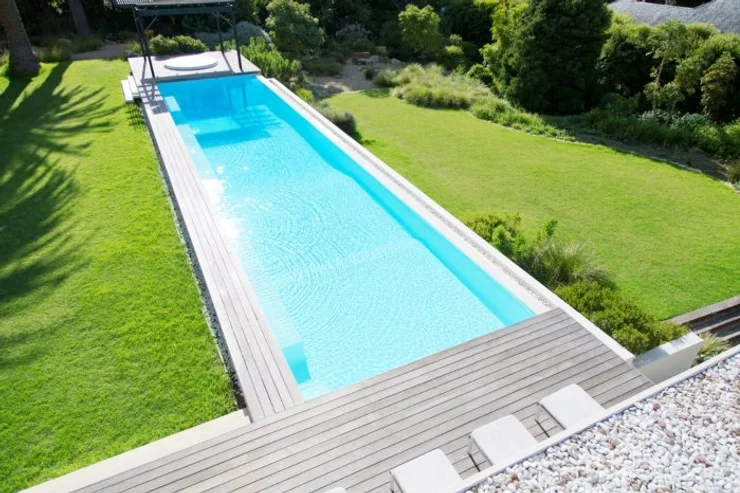
A lap pool is a long, narrow pool built for swimming laps rather than lounging, typically at least 2.5 meters wide and long enough to swim several uninterrupted strokes before turning. It’s a popular choice for homeowners who want a pool for fitness and a clean, linear look rather than a large freeform pool that takes up most of the yard. Because a lap pool’s footprint is narrow, it tends to fit properties where a standard pool wouldn’t.
What Makes a Pool a “Lap Pool”?
The defining feature is proportion, not size alone. A lap pool is built long and narrow, with a consistent, swimmable depth, rather than the wider, irregular shape of a typical backyard pool. Some homeowners install one purely for exercise, others simply prefer the sleek, linear look it adds to a yard alongside a spa or lounge deck.
Typical Lap Pool Dimensions
Home lap pools vary based on lot size and how the pool will be used. The table below outlines general ranges.
A depth of at least 1.5 meters keeps the pool comfortable for swimming laps year-round without feeling shallow at the turn.
Types of Lap Pools
Lap pools are typically built from concrete, fiberglass, or vinyl. Concrete offers the most flexibility for custom length, shape, and finish, but takes longer to install. Fiberglass comes as a pre-formed shell, which shortens installation time but limits size and shape options. Vinyl-lined pools sit in between on both cost and customization. Beyond material, homeowners can also choose between an indoor lap pool, useful in climates with harsh winters, and the more common outdoor version integrated into a patio or backyard layout.
Heating, Lighting and Customization
Because a lap pool is narrow, heating it tends to cost less than heating a larger freeform pool of similar depth, which makes year-round use more realistic in a mild climate. A heater paired with a cover helps hold that temperature between swims rather than losing it overnight. Underwater and perimeter lighting turn a lap pool into a usable evening feature rather than a daytime-only amenity, and both integrate easily with a home’s existing outdoor lighting system. Some homeowners also add swim jets, which create resistance so laps can be swum in place, useful when the lot isn’t long enough for a full-length pool but the goal is still a real workout.
Lap Pool vs. a Traditional Backyard Pool
A traditional freeform pool is built for lounging and gathering, wide, irregular in shape, and often paired with a shallow end for kids or casual use. A lap pool trades that flexibility for a narrower footprint and a consistent swimmable depth end to end. That makes it a better fit for a smaller lot, and for homeowners who want a pool used for exercise more than entertaining. Some properties have room for both, a compact lap pool along one side of the yard with a separate spa or small lounge area nearby, but on a tighter lot, the choice usually comes down to how the pool will actually be used.
5 Things to Consider Before Installing a Lap Pool
- Access and entry points. Steps, a ladder, or a gradual entry all affect how the pool is used day to day, and where they go affects the surrounding deck layout.
- Spa or hot tub integration. Pairing a lap pool with a spa at one end adds a place to relax without taking up additional yard space.
- Decking material. Stone, concrete, or wood decking around the pool affects both the look and how it holds up to pool chemicals and sun exposure.
- How you’ll use it. A pool used mainly for morning workouts has different lighting and heating needs than one meant for evening use.
- A pool cover. Covers help with heat retention, safety, and keeping debris out between swims, especially in a narrow pool where wind can carry more into the water relative to its surface area.
Planning a Lap Pool for Your Home
The right lap pool size comes down to your lot, how you plan to use it, and how it fits with the rest of your outdoor space. If you’re planning a pool as part of a larger backyard design or landscape design project, our team works through layout, materials, and how the pool connects to the rest of your outdoor living space, and we use 3D rendering so you can see the layout before anything is built. Explore our exterior design services, or contact our team to talk through your yard.
We are an interior design studio, not a contractor. We work alongside your licensed Nevada contractor. You hold the build contract; we protect the design.